Monday, August 3, 2015

What Makes Wine Kosher?

From coffeeshoprabbi.com

Periodically I will hear someone say that a food is kosher because “a rabbi said a prayer over it.” Not true. Kashrut is a complex topic, so I’ll tackle in it manageable “bites.”

Since Shabbat is coming, let’s start with wine.

  •     Kosher wine is wine that has been produced and handled only by Sabbath-observing Jews, and for which all ingredients were also kosher.
  •     You can tell if wine is kosher by looking for the hecksher (rabbinical mark) on the label.
  •     The rules for kosher wine go back to ancient times, when wine was used to worship idols. To avoid wine that has been tainted by idol worship, kosher wine must be handled only by observant Jews. This includes the servers who pour the wine.

Continue reading.

Follow us on   


Monday, July 27, 2015

Less than 2% of the US population is Jewish. So why is 41% of the country’s packaged food kosher?

By Deena Shanker for qz.com

Considering how few people keep kosher in the US—Jews make up less than 2% of the American population, and only a portion of them follow Jewish dietary laws—it’s fairly astounding that 40% of the country’s packaged food and beverage products are labeled as being kosher. That makes it the top label claim on food and beverages, according to market research firm Mintel, beating out the ever-present “gluten-free” label and even allergen claims.


“Kosher” food meets the broad range of requirements of Jewish dietary laws. The laws define, for example, which animals are and are not allowed to be eaten (cows and chickens are ok, pigs and shellfish are not), as well as how the animals are slaughtered, and how their meat is prepared; the laws also lay out which foods can and cannot be mixed (no meat with dairy, for example), and even, when it comes to wine, who is allowed to touch it.

Continue reading.

Follow us on   


Monday, July 20, 2015

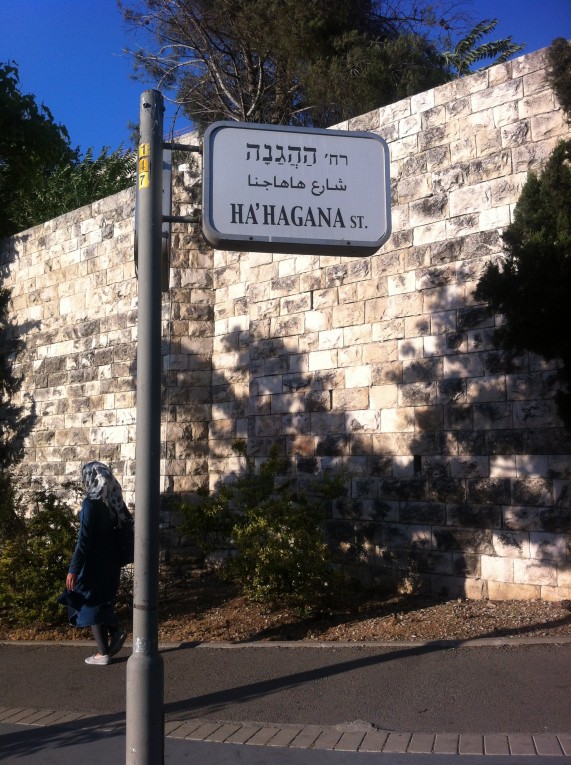
Why all Israelis need to know Arabic

The Blogs-- Anat Peled, The Times of Israel
About a month ago I began teaching English to Arab elementary school students in Tira (an Israeli-Arab village). Presenting myself to the class for the first time, I wrote my name in English, Hebrew and Arabic. I explained in Arabic that I’m Jewish and have been studying Arabic for the past few years. There were some whispers and surprised faces.

“Can you write my name in Arabic?” one girl asked. The girl’s eyes grew wide as I wrote her name. Pretty quickly the kids were all begging me to write their names in Arabic with puppy dog eyes as if they wanted candy

Continue reading.

Follow us on   


Monday, July 13, 2015

Saudi Sunnis, Indian Shiites, and Israeli Jews Meet in India

A visit to Lucknow, India


BY SHIMON SHAPIRA for The Weekly Standard

In May 2015, I visited the Indian city of Lucknow, the most important Shiite center in India. The visit was exceptional in its composition—an Israeli delegation from the Jerusalem Center for Public Affairs, headed by Dr. Dore Gold, and a Saudi delegation from the Middle East Center for Strategic and Legal Studies, located in Jeddah, Saudi Arabia, chaired by Maj. Gen. (ret.) Dr. Anwar Majed Eshki.

Our hosts were the leaders of the Shiite community in Lucknow, the Raja of Mahmudabad, Amir Khan, his son Ali Khan, intellectuals, and teachers of the local madrassa. It was an extraordinary meeting of Jews from Jerusalem, Saudi Sunnis from Mecca and Medina, and Indian Shiites from Lucknow.

For me the visit to Lucknow was a dream come true. I first heard the name Lucknow at a conference that the Dayan Center convened at Tel Aviv University in 1984. It was during the first Lebanon War and Israel’s various intelligence services were groping in the dark in all matters dealing with Shiites, in general, and Lebanese Shiites, in particular. One of the conference topics was about the Shiites of Lucknow.

Continue reading.

Follow us on   


Monday, July 6, 2015

Expensive Dues Aren’t the Only Reason People Don’t Go to Synagogues

Nina Badzin for Kveller

On Monday in the New York Times, Michael Paulson reported on the “Pay What You Want” model some synagogues are implementing to reduce the financial barrier to membership. Paulson estimates about 30 synagogues across the United States are trying voluntary dues.

In Paulson’s words, these changes have come from “an acknowledgement that many Jewish communal organizations are suffering the effects of growing secularization, declining affection for institutions, a dispersal of Jewish philanthropy and an end to the era in which membership in a congregation was seen as a social obligation.”

With those realities, a massive change in the dues structure is necessary, but is it sufficient? Changing the financial requirement for membership without addressing the deeper disinterest in attending synagogue is going to yield more of the same long term: low participation and apathy.

Continue reading.

Follow us on   

Monday, June 29, 2015

Ask the Expert: Joint Aliyot

Can two people be called up to the Torah at once?


By MJL Staff-MyJewishLearning.com

Question: I’ve been to synagogues where groups of people are called up together for one aliyah to the Torah. Sometimes it’s a couple who are about to get married, having a joint aufruf. Other times it’s a whole confirmation class, reciting one blessing in unison. Does this practice have any halakhic justification? Where did it come from?

–Charlie, Washington DC

Answer: I used to have a teacher who told me that the answer to every question in Jewish law is, “There’s a mahloket“–it’s up for debate. This holds true in regards to your question, Charlie. Some synagogue rabbis have decided to offer joint aliyot in their congregations, and others have chosen not to. Who’s right and who’s wrong? It depends who you ask, of course!

Continue reading.


Follow us on   


For more information about the upcoming holidays, check out our Shavuot & Summer Holiday Kit


Monday, June 22, 2015

Dr. Marcel Israel: Sephardic Jews in Bulgaria

From RadioSefarad.com


ENGLISH CORNER, CON LINDA JIMÉNEZ – This week’s trivia question: How many Jews in Bulgaria were saved from the Nazis, and who was instrumental in saving them?

Dr. Marcel Israel is a Sephardic Jew who was born in Plovdiv, Bulgaria, and now lives in Spain. He is the former President of the Jewish Community of Bulgaria, and currently the Secretary and Coordinator of International Relations for the National Council of Religious Communities in Bulgaria (NCRCB). He is also active in Religions for Peace-Europe, where he is Advisor to the President of that organization. Dr. Israel is a speaker of Ladino, also known as Judezmo, and an advocate for the preservation of that language. He has lectured in many countries, including the United States, Turkey, Brazil, Argentina and Venezuela, as well as in Bulgaria and Spain.

Dr. Israel spoke with us about the history, culture and language of the Sephardic Jews in Bulgaria.

Listen