When Susan’s husband, Morton, passed away, a group at her synagogue stepped up and offered support during an incredibly difficult time. People from the Jewish community gathered together, read his poetry - his prayers - as they all remembered him together. It was a beautiful, nontraditional farewell.
Monday, August 24, 2015

Monday, August 17, 2015
Berlin Just Hosted the Biggest Shabbat Meal Ever

The logistics of a big Shabbat meal can be a bit daunting—especially so when over 2,000 Jewish men and women attend.
On a recent evening in Berlin, exactly 2,322 Jews converged for what is now, officially, the world’s largest Shabbat meal of all time. So speaks the holy scripture of the Guinness Book of World Records. That’s right: Berlin beat out Tel Aviv, which last summer fed a mere 2,226 hungry souls.
Continue reading.
Follow us on

Monday, August 10, 2015
I Don't Care About Jewish Tribal Loyalty — And That Doesn't Make Me Anxious

The angst some American Jews feel over Jewish identity is captured beautifully in a recent essay by Gal Beckerman . As the outgoing opinion editor for the only national Jewish newspaper, he’s certainly had his ear to the ground. But it’s a very specific section of the ground: those who bother reading and debating in Jewish newspapers.
I know those folks. I work regularly with synagogue leaders, Jewish clergy, and others at Jewish communal organizations, and don’t disagree with the description of a “gut-churning, fraught, panicked and uncomfortable state…. of not really knowing anymore what it means to be a Jew.”
But that’s not how I feel. And I don’t think it describes how the majority of American Jews feel. Perhaps it’s just the majority of the 30% who are deeply engaged in the organized Jewish community.
Read more:
Follow us on
Monday, August 3, 2015
What Makes Wine Kosher?

Periodically I will hear someone say that a food is kosher because “a rabbi said a prayer over it.” Not true. Kashrut is a complex topic, so I’ll tackle in it manageable “bites.”
Since Shabbat is coming, let’s start with wine.
- Kosher wine is wine that has been produced and handled only by Sabbath-observing Jews, and for which all ingredients were also kosher.
- You can tell if wine is kosher by looking for the hecksher (rabbinical mark) on the label.
- The rules for kosher wine go back to ancient times, when wine was used to worship idols. To avoid wine that has been tainted by idol worship, kosher wine must be handled only by observant Jews. This includes the servers who pour the wine.
Continue reading.
Follow us on
Monday, July 27, 2015
Less than 2% of the US population is Jewish. So why is 41% of the country’s packaged food kosher?

Considering how few people keep kosher in the US—Jews make up less than 2% of the American population, and only a portion of them follow Jewish dietary laws—it’s fairly astounding that 40% of the country’s packaged food and beverage products are labeled as being kosher. That makes it the top label claim on food and beverages, according to market research firm Mintel, beating out the ever-present “gluten-free” label and even allergen claims.

“Kosher” food meets the broad range of requirements of Jewish dietary laws. The laws define, for example, which animals are and are not allowed to be eaten (cows and chickens are ok, pigs and shellfish are not), as well as how the animals are slaughtered, and how their meat is prepared; the laws also lay out which foods can and cannot be mixed (no meat with dairy, for example), and even, when it comes to wine, who is allowed to touch it.
Continue reading.
Follow us on
Monday, July 20, 2015
Why all Israelis need to know Arabic
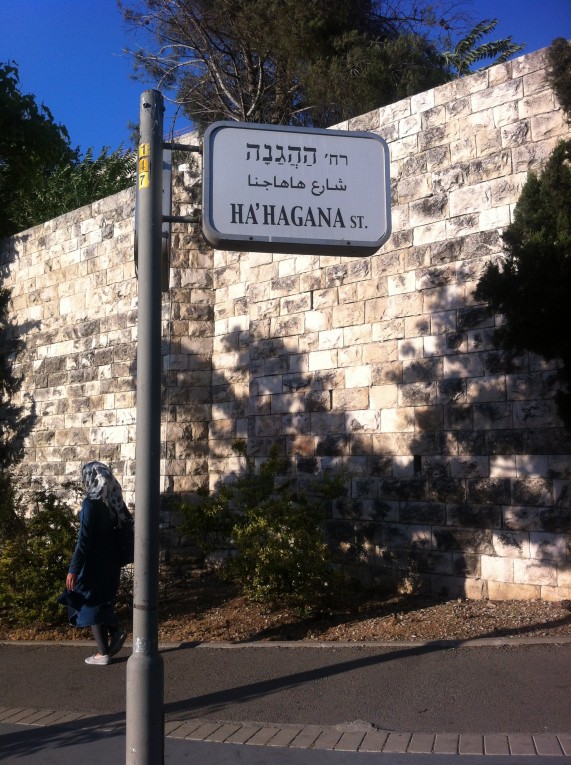
About a month ago I began teaching English to Arab elementary school students in Tira (an Israeli-Arab village). Presenting myself to the class for the first time, I wrote my name in English, Hebrew and Arabic. I explained in Arabic that I’m Jewish and have been studying Arabic for the past few years. There were some whispers and surprised faces.
“Can you write my name in Arabic?” one girl asked. The girl’s eyes grew wide as I wrote her name. Pretty quickly the kids were all begging me to write their names in Arabic with puppy dog eyes as if they wanted candy
Continue reading.
Follow us on
Monday, July 13, 2015
Saudi Sunnis, Indian Shiites, and Israeli Jews Meet in India
A visit to Lucknow, India

BY SHIMON SHAPIRA for The Weekly Standard
In May 2015, I visited the Indian city of Lucknow, the most important Shiite center in India. The visit was exceptional in its composition—an Israeli delegation from the Jerusalem Center for Public Affairs, headed by Dr. Dore Gold, and a Saudi delegation from the Middle East Center for Strategic and Legal Studies, located in Jeddah, Saudi Arabia, chaired by Maj. Gen. (ret.) Dr. Anwar Majed Eshki.
Our hosts were the leaders of the Shiite community in Lucknow, the Raja of Mahmudabad, Amir Khan, his son Ali Khan, intellectuals, and teachers of the local madrassa. It was an extraordinary meeting of Jews from Jerusalem, Saudi Sunnis from Mecca and Medina, and Indian Shiites from Lucknow.
For me the visit to Lucknow was a dream come true. I first heard the name Lucknow at a conference that the Dayan Center convened at Tel Aviv University in 1984. It was during the first Lebanon War and Israel’s various intelligence services were groping in the dark in all matters dealing with Shiites, in general, and Lebanese Shiites, in particular. One of the conference topics was about the Shiites of Lucknow.
Continue reading.
Follow us on
Subscribe to:
Posts (Atom)